Tuesday, December 21, 2010

Into Bolivia

The plan was to leave San Pedro and get to the border at around 12.30 leaving about four or five hours to cover the last 200km into Uyuni. Well that was the plan. The last 100km to the border on the Chilean side is dirt road, and not very good at that. 


The Bolivian border

So I arrived at the border at three o’clock and departed Chile no problem in about 15 minutes. Then I rode the 2km to the Bolivian border. It was four thirty when I finally got the importation papers for the bike stamped and I was able to continue. The next 70km took me three hours! It’s some of the worst road I think I have ever taken the Wombat onto. Loose gravel, dust, and patches of sand all came at me without warning or rhythm. A strong tail wind and reasonable temperature kept the motor temperature on the maximum for the whole time and luckily the average speed was low enough to give me very good fuel consumption, because there was nowhere in sight to get fuel (why hadn’t I filled the spare container??) So when the first small village came into sight and there was a picture of a bed on one of the signposts, I thought that would do for the night. $7 bought me a bed, a shower and a good hot meal, in one of the poorest looking places I think I have seen. But I was really thankful for it.
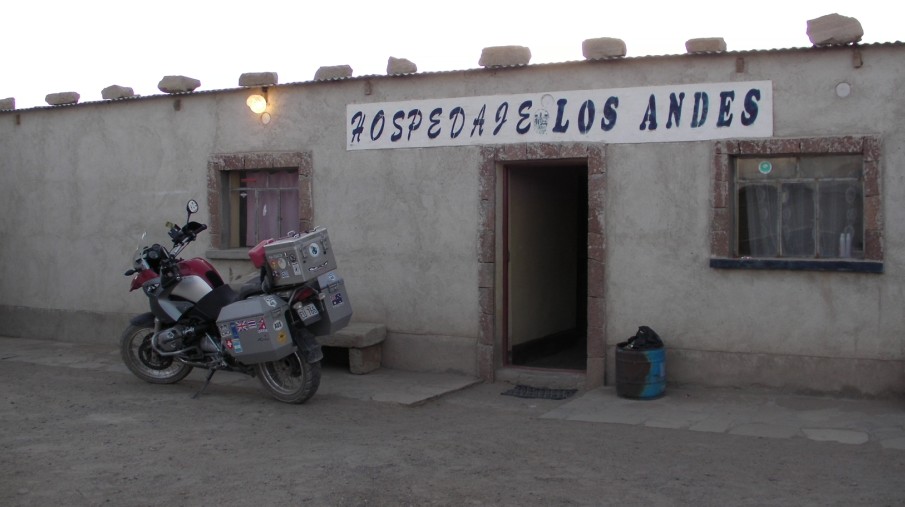

The First nights Hotel for $7


The Village in the morning


The local brick works


Villa Alota village square


Down onto the first small Salar. The signpost is for mines either side of the road!!

I set off again the next morning at what I thought was 08.30. In reality it was 07.30 as the clock should have gone back an hour when I crossed the border! I spoke to three Argentinean lads on various 650’s going towards the border, and they confirmed my fears that the road did not get any better before Uyuni. So the next 130km was a bone-rattling ride with the last 50km consisting of the worst corrugations I have come across. I seriously had a good look at the Wombat the next day to make sure nothing had broken.


Scenery good, road bad!!

Uyuni has one thing going for it, it’s next to the Salar. If not for that then nobody would go there. I booked a tour the next day with one of the many companies in town. I didn’t want to do the three day excursion which most of the backpackers do, I figured two days and one night was as much as I needed.


Uyuni


The train graveyard


The Salar is a spectacular sight. It’s the larges salt flat in the world, followed by Utah, and the Salar de Atacama. Fleets of land cruisers head out every day, and usually end up in the same place at the same time. The only way to have it any different is to use your own transport. If I had been with someone else, or if I had the knowledge I have now I would have done it, but I don’t think it’s the place for taking chances. The overnight accommodation was interesting. A hostel made entirely out of salt, but no showers and beds that would make a door look comfortable. I was the only one that got up to see the sunset out of our party, although there were two Argentineans that had arrived the night before in their own car, and had been there before, set off to see the sun rise over the salt. A visit to the island Incahuasi, which is a coral island in the middle of the salt flats, not only gives you some magnificent views of the flats, but also is covered in Cactus.


The Salar De Uyuni


The Volcano


Flamingo's at dawn


Overnight accommodation in the Salt Hostel


The Hostel on the edge of the Salar


Dawn on the Salar


Incahausi Island


One more night in Uyuni to recover and get clean before heading out for Potosi. The road is about 70% tarmac and 30% dirt. They have obviously been working hard recently to complete the valley sections of the road which is now very nice smooth tarmac, until you come to the hills which are still dirt and in places soft sand.


They're working on it


The down side is that people will miss this when the road is done

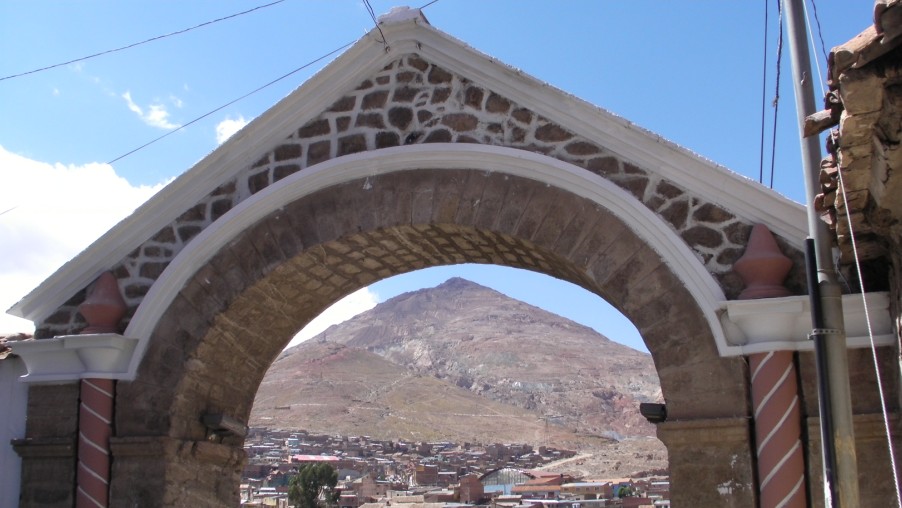
Potosi is one of the highest cities in the world at 4000m. Perched on the slops of the hill that contains the Cero Rico mine, and has brought prosperity to the place since the 15th Century. When the Spanish arrived the spirits had already told the locals, that the silver in the mountain was not for them but for strangers that would come from far away. There was little opposition to the Spanish who then started to mine, and process the silver here. Pieces of eight

Were sent from here to the Spanish Main to be transported to Spain with the Privateers and Pirates waiting to try to stop them. The mint today is a museum, which gives a fascinating insight into how important a place this was. The other main tourist attraction is to visit the co-operative mines that still work the hill behind the city. I passed on that. The elevation combined with the potential danger of visiting what can only be described as sub standard working conditions at best, to see people working there way to an early grave did not appeal.


Potosi


Cero Rico Mountain


The Old Mint

So after two nights I headed out again for Sucre, and the promise of tarmac all the way.

Tuesday, December 14, 2010

San Pedro de Atacama

I wasn’t sad to leave Antafagasta, it’s a town that has been corrupted by the wealth of the mining that surrounds it. I didn’t feel welcome or satisfied by my visit in any way. So in my opinion “the pearl of the north” has become a little dull. So it was back into the desert and heading northwest towards Calama then southwest to San Pedro De Atacama. The climb is so gradual you don’t notice it until I stoped to take the fleece off and checked the altitude. It was 3251m. There is then a steep drop down to only 2500m into the town. I had already selected a list of three Hostels to stay at and all were full!! I asked at another that didn’t look that appealing, and that was full too. It’s the trouble with travelling alone on a bike that everywhere you stop you have to carry your helmet, tank bag (with all the valuables) and dressed in all the motorbike gear in 40 degrees heat looking for reasonable priced accommodation soon becomes hard work. The next Hotel I pulled into was supposed to be $120 a night. I said that if they could do it for $100 I’d take it. So I’m in the Hotel Tulor. Which I have to say is very nice.

The next morning I elected to take a tour up to see the Tatio Geysers. Unfortunately this involves a 04.00 departure!! After we had collected a bus full we set off on a dirt road in the dark climbing fairly steeply all the way until we reached the plateau just on dawn at 4300m. Any sort of exercise at this altitude makes you breath harder and your head thump as the body cries out for what little oxygen there is. The outside temperature is either close to or below freezing which combined with the thermal activity of the geysers makes for the most spectacular spurts of hot water. This was the reason for such an early start, because as soon as the sun appears over the volcanic mountains that surround this place most of the activity stops.


The older pools are larger, but only one has a water temp of around 34c where people can swim if they want. The water in the others is around 95c, which produces clouds of steam in the cold morning air.

On the way back to town we visited a “tourist” village, which is constructed in the same adobe brick style that it would have been hundreds of years ago. Also one of the old water courses from the high mountains down into the valley where the cactus grows catching the evaporating water vapour from the stream. There has been no rain at all in this region for the last ten years, so the cactus are starting to get a little pointed at the top as the growth slows.


San Pedro de Atacama exists for the tourist trade, apart from the Hostels, Hotels and restaurants there is nothing else here. It’s a nice place though just to relax, do the tours and acclimatise a little to the altitude. The town is built of the adobe brick, which gives it a rustic feel. And for whatever reason there seems to be a lot of Rastafarians about?? Along with the packs of dogs that roam the streets, and that like to bark a lot at motorcycles. There are also a lot of backpackers, which is one of the reasons the Hostels are full. My advice is to book three to four days ahead when heading this way.

The tour for the Moon Valley starts at 16.00 when the temperature was still in the high 30’s. A short drive out of town and you turn off to have a look at the “valley of Death” first then back across the road to an amazing landscape. Apparently this was the place that NASA used to develop it’s vehicles for the moon, as it’s the closest thing on earth to the surface of the moon. The surprise of the tour is when the guide leads you into a tunnel that some people were backing out of because there was no light. The guide had a LED panel and we then proceeded into a very tight at times Lava Tube, emerging a few hundred meters later back into the sunlight with a sigh of relief. The finale is a climb up to the top of a very high sand dune to watch the sunset and the changing colours of the desert.


The Valley of the Moon


Into the Lava tube


The Amphitheatre


Climbing the Dune, hard work at 3600m!! 

Top of the dune


Wednesday, December 8, 2010

North to the Atacama


What an interesting day that was. It all started off innocently enough, and luckily it's Saturday, so the traffic leaving Valparaiso was light, and all the way through Vina Del Mar. I was enjoying the hills mountains and all the fruit orchards, and then the first tunnel appeared. It was only wide enough for on vehicle, but it was controlled by traffic lights. 


The first tunnel

The second tunnel was the same, but no traffic lights and no asphalt, and the road/asphalt had disappeared on the other side to, for about 40km. Where the hell did that come from?? So now the bikes filthy.

La Serena appears to be a lovely town, although I haven't seen much yet. There was some sort of fiesta going on in the centre today, but I've found a nice little apart hotel right down on the beachfront. I'll go exploring tomorrow.


I’m not one for seaside towns, but La Serena has been one of the exceptions. Long stretches of good beach, and an old town to make life a little more interesting. The mornings along this part of the coast in Chile tend to be overcast and a brisk onshore breeze, which keeps the temperature down. I’ve spent enough time in the sea to know when it’s going to be cold., that plus a lack of anyone in the water made sure that a swim was out of the question, but a good lunch with half a bottle of very good Cabernet Sauvignon, finished off a day of sightseeing.

Another cloudy morning the next day meant the ride up to Copiapo started cool, and it never really warmed up, but the scenery soon started to change as I left “district three” and entered the Atacama region. Heading north the last 100km gives you a taste of what is to come as you enter the desert.


Copiapo came to the world’s attention on the 5th August in 2010 when a collapse in the San Jose Copper/Gold mine trapped 33 men underground. The town is dominated by the mining industry. As you enter the town there are service industries for every type of heavy machinery you can imagine. That aside the money that comes with mining is here, along with the shops and restaurants, and I spent a very nice night in the Hotel La Casona.

I passed the road to the mine as I left the town the next day and continued north towards Antafagasto and into the desert. This day I was prepared for the temperature and had put a fleece on underneath my jacket, and put some warmer gloves on. You soon realise how big, and how dry the Atacama desert is. It’s the most desert like desert I’ve ever seen, if that makes any sense.


With one other major town between La Serena and Antafagasto it’s a day of the alternative scenery, and plenty of time to sort things out in your mind as you ride. Just before you reach your destination you come across the giant sculpture by the Chilean artist Mario Irrizabal known as “La mano del desierto” or The Hand of the Desert. From the road it looks as though some giant is starting to reach up out of the desert towards the sky.


I'm heading to San Pedro de Atacama next. Hopefully the wifi will last until there. After that it's Bolivia, and who knows what??

Valparaiso

Valparaiso is the biggest port in Chile. It also has the dubious title of the cultural capital of Chile. I entered the city on Wednesday the 1st of December, the same day hundreds of people had decided to protest about something!! It really doesn’t help when you are a) trying to navigate in a strange city and b) the GPS maps are incomplete and suddenly say, “Cannot calculate route” and leave you sitting there. Eventually I found the Tourist information office down by the port entrance and asked if they had a list of Hotels? They asked how much I wanted to spend and my answer of $50 was not received well. I soon decided that the budget was going out the window and after a couple of calls I checked into the Diago De Almagro Hotel, a brand new four star Hotel with a view straight out onto the bay. They deal the tourist information office got me was very good in comparison to the regular check in rates. Expensive? Yes, but oh how nice.


The view from my bedroom

Although a port, Valparaiso is surrounded by hills, and over the hundreds of years the buildings have spread all along the hillside at the back of the city. Some grand and some ramshackle, it has become a colourful mix, that looks like it it now becoming more fashionable to restore and live in. There are old cable cars that for 1 peso will carry you from the hustle and bustle of the city centre streets below to the cool and quiet cobblestone streets that look out over the bay.


One of the old cable cars


I think the same cable company the got the contract for Phuket got the contract here, the OH&S people would have a fit if they saw this.


Friday, December 3, 2010

New Video

Just to let you know I´ve managed to put together the first half of Argentina in a video.

Tomorrow off to La Serena.

Thursday, December 2, 2010

Santiago

Santiago City is huge, but the evidence of wealth is instantly obvious. The amount of consumer goods and variety of cars shows the amount of imports and lower import taxes. After a good nights rest (an early one after the last week) I headed out on the Sunday to firstly explore the park just behind the hotel, Cerro Santa Lucia, from which you get a good view of the city and an idea of the amount of pollution over the city that stops you getting a view of the mountains just behind Santiago.


Cerro Santa Lucia


There are mountains back there somewhere


I also met an American man, Rene Brauchtsch, who was here to see the Doctors at the local hospital (he must be in his late 70’s) he said that he was going to a shopping mall the other side of the city in the afternoon and invited me along, sure why not, he speaks excellent Spanish, having been marries to a Chilean woman for 50 years. It turned out that the mall was only a ten minute walk from the BMW agent that I was to visit for the tyres the next day, bit it was a chance to try out the subway system and see the affluent side of Santiago getting ready for Christmas.


I´m sure I haven´t been here before


Apparently one of the more Bohemian districts


The Cathedral Square

This was not Rene’s first visit here, so he knew so good restaurants around the Hotel so we had diner together that night, and a very large lunch on our last day. He’s from New York out on Long Island, so I have promised to call him when I get there next year.

Tuesday was a ride through the busy traffic to the dealer to get some new rubber on the Wombat. Initially they said I would have to leave the bike and come back the next day, but a sorry face and asking nicely got the tyres on and me safely back to the Hotel by three o'clock. $630 lighter in the wallet. So I should now be OK until I reach the USA.

San Martin to Santiago

We picked the bike up the next day all correct and ready to go. They had even washed it and blacked the tyres!! The cost was about the same as I would have paid in Oz so no complaints there, and I have another stamp in the book from another country to go with the one from Tehran.

Thursday night got interesting as a work colleague of Jorges was getting married at the weekend and we were invited to the bucks night dinner. Nothing out of control but a reasonable amount of vino was consumed and we didn’t get home until three in the morning!! Mind you we didn’t go out until ten thirty.

The last night in San Martin was another Asado at Jorge’s house. This time I insisted on paying for the meat as a thank you. All had a good time as you can see from the pictures.


Jorge´s son Julio


Jorge and Ingrid


Seasoning is important


A good evening

The next day I packed the Wombat and headed out of the town towards the mountains. The day started off very cloudy, but Jorge assured me that it would clear as I got higher. The climb on the Argentinean side is a steady on with gentle curves through a valley with the river flowing enough to allow rafting and other water sports in the summer, and a lot of evidence of skiing in the winter. The temperature starts to drop and as you reach the summit at around 2800m, any of the steeper climbs are noticed by the drop in power from the engine. Not that it affects it to any great degree, it just means that a drop in gear is required. As you pass the entry customs into Argentina (which you do not have to stop at) you come across the national park entrance for Acongagua, the highest peak in South America. This was the only place for a photo opportunity, and luckily the cloud had disappeared and the sun was out. Mind you I didn’t hang around too long as the temperature was low enough to make me wish I’d kept the fleece handy for underneath the jacket.


Acongagua the highest mountain in South America

Next stop was the customs post for Chile, where the exit from Argentina, and the entrance to Chile, are all in the one place. As probably the major border crossing it’s a bun fight with coaches galore, and a lot of cars. Coach drivers trying to get their passengers through as quickly as possible try to tell you which que you need to be in, not knowing what the customs officers have already told you, so in the end I lost it with one of them who kept telling me I was in the wrong que. I asked him if he was a customs officer and when he replied no, I told him to mind his own business and leave me alone! One hour later with the quarantine inspection done I was on my way again. The decent from the summit is a very different affair. A series of hairpin bends take you down very quickly and if I hadn’t stopped to take so many photos it could have been a very hairy ride on the bike.


Santiago is only another 160km after that and a nice easy run in on the motorway puts you in the middle of the city and my hotel.